Introduction: Enterprises are increasingly looking to turn AI investments into business outcomes, but delivering effective AI applications requires timely access to relevant, contextual information. This is where an optimized vector database becomes essential, enabling developers to retrieve relevant enterprise information through semantic search and deliver it as context to AI models at inference time, with the performance and scalability that production applications require.
Elasticsearch Vector Database, a new serverless offering, aims to simplify the development of semantic search, RAG, AI agents, and recommendation applications by combining retrieval capabilities within a managed platform. Customers would rather spend their expertise on value-added tasks rather than manually fine-tuning a vector index. Vector compression reduces storage and memory requirements as datasets grow; Elastic says the platform scales to hundreds of billions of vectors. Customers want to estimate costs; that is not always possible for vector workloads. By managing the retrieval infrastructure and optimizing how vectors are stored and searched, Elastic aims to reduce operational overhead while giving customers greater visibility into costs as workloads grow.
In the sections below, RobustCloud examines how well the three promises of ease of use, efficient scale, and cost predictability address the challenges organizations typically face in their AI journey.
Retrieval is a business problem, not plumbing.
Although retrieval is often treated as a technical detail, its quality directly influences the accuracy and business value of AI applications. An incorrect customer record, outdated policy, or a less relevant document can all yield a convincing answer that is still wrong. As a result, better rankings with relevant products, documents, and answers deliver more value.
Retrieval quality and handling loads can make a big difference as an AI application moves into production. A hybrid retrieval approach combines the strengths of keyword and semantic search. Keyword search is ideal for finding exact terms, such as product names, technical identifiers, or specific phrases, while semantic search understands a query’s meaning and finds related information even when different words are used. Combining these approaches improves relevance by capturing exact matches and semantically related information while giving AI applications a stronger foundation for generating reliable responses. For AI agents that run multi-step retrieve-reason-retrieve loops per request, Elastic provides low-latency, filtered retrieval across tools, documents, and conversation memory.
Some Assembly Required
Beyond choosing a vector database, enterprise retrieval systems require teams to integrate embedding models, indexing, search, and reranking capabilities while managing security, performance, and scalability. Specialized vector databases are reasonable alternatives but customers should weigh the cost of additional integration as applications evolve. General-purpose data platforms also offer broader functionality but with implementation complexity. Elastic’s opportunity is to help customers reduce these trade-offs through a unified retrieval platform.
Unifying the Stack into a Single Request
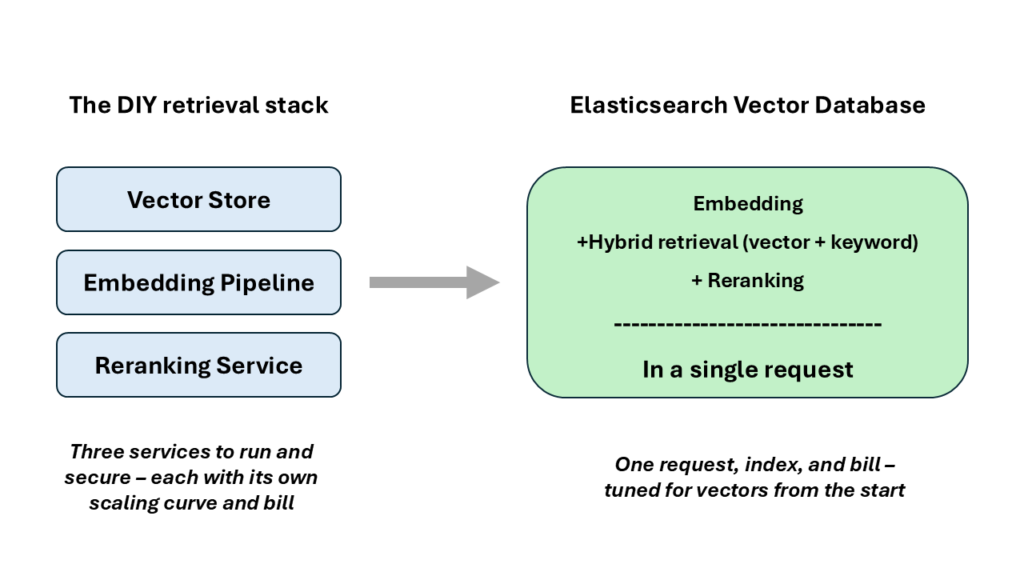
Elasticsearch Vector Database’s central value proposition is enabling developers to deploy retrieval-powered AI applications quickly without taking on the complexity of managing the underlying infrastructure. The customer brings documents and queries while the product handles the embeddings, index tuning, and the underlying infrastructure. The embedding, hybrid retrieval, and reranking occur within a single request rather than across multiple services. Here is how it works:
· Managed embedding and indexing: The semantic text field handles embedding, chunking, and index configuration at ingest and query time. This eliminates the need to stand up and maintain a separate embedding service. Jina AI models provide integrated embedding and reranking capabilities required for each stage of the retrieval pipeline and run on the Elastic Inference Service (EIS). Although Jina AI models running on Elastic’s managed GPU inference can do this task, teams that prefer their own models can bring them instead.
· Hybrid retrieval in a single index: The Vector and keyword searches run together across text, image, and multimodal data on a single index, together with native reciprocal rank fusion (RRF). A pure-vector engine cannot reach this level of relevance on its own.
· Integrated Reranking: Reranking occurs within the same retrieval request, eliminating the need for a separately managed reranking service and reducing network overhead.
The real value is eliminating the integration work between services, turning what previously required multiple components into a unified retrieval request.
Tuned for Vectors, Priced for Scale
As AI workloads scale, storage efficiency, search performance, and automated optimization become critical to controlling infrastructure costs. Elasticsearch Vector Database includes several built-in optimizations designed to improve resource efficiency, as described below.
The first is compression, which shrinks numerical data so it fits in less memory, reducing hardware costs while preserving retrieval quality. Better Binary Quantization (BBQ) compresses vectors by up to 32x and uses 95% less memory while preserving ranking quality. The vectorDB document index mode is enabled by default, uses bfloat16, halves the disk footprint, and excludes duplicate source vectors.
Another capability is query acceleration, where the ACORN-1 algorithm makes filtered vector search roughly 5x faster with typical filters and considerably faster with highly selective ones by integrating the filter into the search itself rather than applying it afterward.
Auto calibration further improves scaling efficiency, automatically tuning quantization, preconditioning, and oversampling to the indexed data to improve recall.
All these capabilities are shipped by default or can be opted into, reducing the need for manual tuning.
Evidence from Customer Deployments
Product proof of pricing lies in customer use cases. For Elastic, such evidence comes from GitHub, which runs semantic search across large volumes of documents with lower infrastructure costs, and from Corvian, which reports 40% faster query times at 99% uptime. Other examples include Tavily, which uses Elasticsearch’s hybrid search (keyword + semantic/vector) to power a real-time AI agent layer for 1M+ developers, and DocuSign, which manages millions of agreements and can scale to billions with greater value and cost efficiency.
Enterprise Readiness
Beyond retrieval performance, enterprise AI applications need features such as governance, security, and integration with existing data sources. Bundled features such as role-based access control, audit logging, and compliance are preferred over integrating add-on services separately. To meet expanding business needs, Elastic’s platform supports 100+ languages, enabling multilingual document sets and combining semantic/vector search with analytical rollups in a single query. For simplicity, enterprises prefer a single system for both embeddings and guardrails. Existing Elastic customers can benefit from familiar operational and governance capabilities, while new customers can avoid the burden of integrating multiple retrieval services.
The Hurdles Ahead
While the capabilities of the Elasticsearch Vector Database are promising, there are challenges in convincing some customers in the following situations:
1. Pure-play vector database vendors position themselves as AI-native, attracting start-ups that may gravitate towards them. Elastic will have to overcome the branding challenge with its technical capabilities.
2. For customers that already own a data platform, several factors such as switching costs and data gravity make it hard to accept a new platform. While Elastic may struggle to replace a data platform, it may still find opportunities with these customers for new workloads.
Elastic could overcome some hurdles by enhancing features such as comprehensive, workload-aware tuning of the Vector Database’s settings.
Conclusion:
Elasticsearch Vector Database addresses a constant challenge in enterprise AI by transforming retrieval from a collection of independently managed services into an integrated, scalable capability. By combining embedding, hybrid search, reranking, and vector-specific optimizations, Elastic reduces the development and operational effort required to bring retrieval-powered applications into production.
The advantage extends beyond simplifying the retrieval stack. Value from storage compression, query acceleration, and automated optimization directly helps justify the deployment of AI applications at scale. Taken along with a more predictable pricing model, these capabilities strengthen Elastic’s value proposition for enterprises trying to move beyond experimentation and into production. Elastic’s long-term success will depend on whether customers will be able to measure the value gained in comparison to specialized vector databases and existing enterprise data platforms. Production use cases that validate retrieval quality, operational efficiency, and total cost of ownership will ultimately determine whether Elastic can translate its technical capabilities into broader enterprise adoption.