
Introduction
IBM acquired Red Hat for $34 billion and preserved its independence, which is paying off, as evidenced by Red Hat’s continued growth. Acquisition success depends on how acquired companies are integrated into the acquiring organization. IBM retained Red Hat’s open-source culture and ecosystem, which had made both organizations successful, by leaving Red Hat alone. Consequently, Red Hat’s OpenShift platform is now an essential piece of IBM’s hybrid-cloud strategy.
Compared to its Red Hat acquisition, IBM appears to be taking a different approach with its HashiCorp acquisition and the upcoming Confluent acquisitions. Rather than combine them with Red Hat’s developer platform ecosystem, these organizations are being integrated directly into IBM’s software portfolio. It is appropriate to question whether developer-centric companies can maintain their innovation advantage when absorbed into an enterprise structure like IBM.
During recent trips to South Korea and India, I met folks familiar with IBM, HashiCorp, and Confluent. The challenges that accompany IBM’s enterprise acquisitions are evident in these conversations.
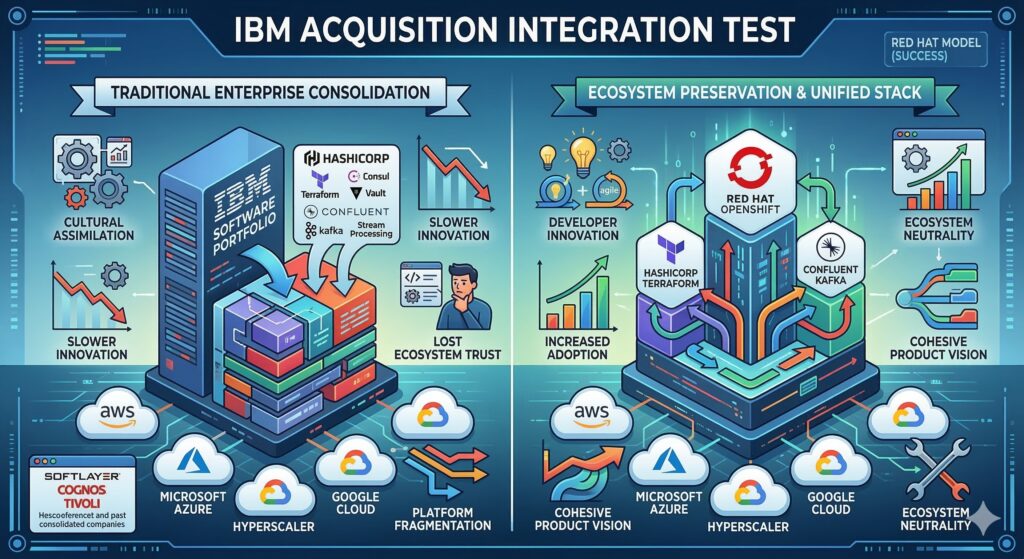
Four Challenges Facing IBM’s Acquisition Strategy
1. Cultural Assimilation
Technology acquisition return on investment depends on the
alignment of corporate cultures. Smaller companies are agile and can deliver at
rapid iteration cycles. The emphasis on governance and the impedance caused by
standardized processes bring rigidity to processes.
When asked about challenges, people familiar with recently
acquired companies expressed concerns about IBM’s culture. Those familiar with HashiCorp
did not like the back-to-office shift, while others knowledgeable about
Confluent were uncertain about a potential mismatch in engineering culture.
While not limited to IBM, acquisitions often trigger
departures among engineers and product leaders, thereby reducing their value. IBM
encountered similar dynamics in earlier acquisition cycles when integration
slowed decision-making and reduced the agility.
2. Platform Fragmentation
Using Red Hat’s OpenShift as the Kubernetes-based container
platform for enterprise workloads, IBM and Red Hat partner with hyperscalers
such as AWS, Microsoft, and Google Cloud. HashiCorp, with its
infrastructure-as-code tools, and Confluent, with its streaming platform, align
with this ecosystem to form a modern cloud-native stack.
Combining HashiCorp and Confluent technologies with Red
Hat’s Kubernetes platform would be ideal for an end-to-end stack. However,
including these technologies in IBM’s software portfolio generates multiple
product strategies, missing the opportunity to present customers with a
cohesive product vision. Without a combined stack, people familiar with IBM
expressed concern about how to explain overlapping capabilities to customers.
3. Ecosystem Trust
The success of HashiCorp and Confluent was predicated on the
tools being neutral across cloud providers rather than on a vendor-controlled
platform. Developers trusted these platforms as tools that adhered to ecosystem
standards. This helped with high adoption in DevOps workflows and real-time
data architectures.
By bringing HashiCorp and Confluent into IBM, Red Hat loses
its open-source credibility with developers. Maintaining the perception that
these technologies remain open-source and neutral within the ecosystem is
important for their continued popularity among developers.
A Competitive Perspective
Every acquisition is handled differently by technology
companies. As an example, Microsoft kept GitHub independent, allowing it to
retain its brand identity, developer governance model, and ecosystem
neutrality. So far, this approach has helped developers maintain confidence
that the platforms would remain accessible rather than become tightly
integrated into Microsoft. Microsoft benefited indirectly from increased
adoption of Azure. This is a very different approach from Microsoft’s past,
when some Office products worked better on Windows than on Apple products.
This strategy pays off in the long run, as Microsoft’s
investments are likely to benefit from the long-term growth of the companies it
has acquired.
IBM’s Opportunity
HashiCorp and Confluent are well-known in the cloud-native
ecosystem and widely used by a wide range of organizations. HashiCorp did not
make friends in the open-source community with its 2024 cease-and-desist letter
to the Linux Foundation. Just like Redis and MongoDB, both companies undermine
trust by imposing restrictive license terms. If IBM maintained the open-source
heritage of these companies and thoughtfully integrated them into Red Hat, it
would be popular not only among enterprises but also among startups.
If IBM can preserve the innovation cultures in these
companies and carefully combine them with Red Hat’s strengths, the acquisitions
can help retain employees and help customers understand how to utilize the
capabilities.
Implications for CIOs and Enterprise Architects
There are several implications for organizations building
hybrid and multi-cloud architectures.
1.
Platform alignment: Enterprises need to have a
platform that combines infrastructure automation, container orchestration, and
an event-driven data pipeline to build modern applications. CIO’s should keep
an eye on how IBM positions HashiCorp and Confluent relative to Red Hat to
ensure all the components work well together.
2.
Ecosystem Neutrality: Enterprise architects
should demand that infrastructure tools like Terraform and streaming platforms
like Kafka support ecosystem standards and operate seamlessly across multiple
cloud providers.
3.
Portability: It is important to keep an eye on
product roadmaps that continue to keep the platform portable across hyperscalers.
To summarize, the three issues that CIO’s should keep in
mind:
·
HashiCorp’s neutrality across all hyperscalers
·
Terraform’s integration with OpenShift and IBM
Cloud Automation
·
Interoperability of Kafka-based streaming
services across hybrid environments
The success of IBM’s acquisition strategy will depend on how
well the technologies are delivered to enhance developer productivity while
maintaining enterprise flexibility.
Implications for Investors
Whether IBM acquisitions translate into revenue growth
opportunities will be an important indicator for its profitability. Long-term
value depends on the continued value for developers, which will increase
adoption. As with every acquisition, IBM salespeople can push new products to
current customers, but that has a limited impact. A true contribution to the
bottom line will be proven only if new customers adopt these products.
If product innovation is slowed and customers are confused
by portfolio fragmentation, the financial benefits of these acquisitions will
take a long time to materialize, or, worse still, never materialize. Investors
should evaluate the clarity of IBM’s roadmap and assess the extent to which it
will expand IBM’s hybrid cloud revenue versus merely add standalone products to
a complex portfolio. The financial upside will depend on the creation of an
integrated developer platform that drives additional software and consulting
revenue.
Conclusion
IBM’s history includes instances in which it has failed to
deliver consistent value to customers and investors. SoftLayer, Cognos, and
Tivoli lost momentum after being combined into IBM’s product portfolio. In the
case of the HashiCorp and Confluent acquisitions, IBM is facing a range of
challenges to success. The integration process must ensure that the acquired
companies’ innovative qualities are not compromised.
IBM’s acquisition of Red Hat demonstrated that developer
ecosystems expand when they are independent. IBM has not articulated the
reasons for returning to the traditional acquisition-and-integration strategy.
While the acquisitions of HashiCorp and Confluent are sound, the test will be
on whether IBM’s acquisition strategy can evolve from traditional enterprise
consolidation to preserving an ecosystem.