
The headlines from the most recent Amazon’s re:Invent conference highlighted faster inference, lower latency, and more capable foundation models. While foundation models continue to improve, enterprise AI adoption has been hindered by a lack of trusted integration and orchestration layers. (See Figure 1). This is why partnerships, not models, will define the next phase of Generative AI: Agentic AI, systems that are capable of independently organizing and completing multi-step actions. Automating business-critical processes with Agentic AI promises to create differentiated enterprise value. Partnerships between market leaders address the challenges that hinder the adoption of Agentic AI. This write-up reviews the AWS-Workato collaboration and highlights the strengths of each company while explaining how the partnership drives customer success through orchestrated connectivity.
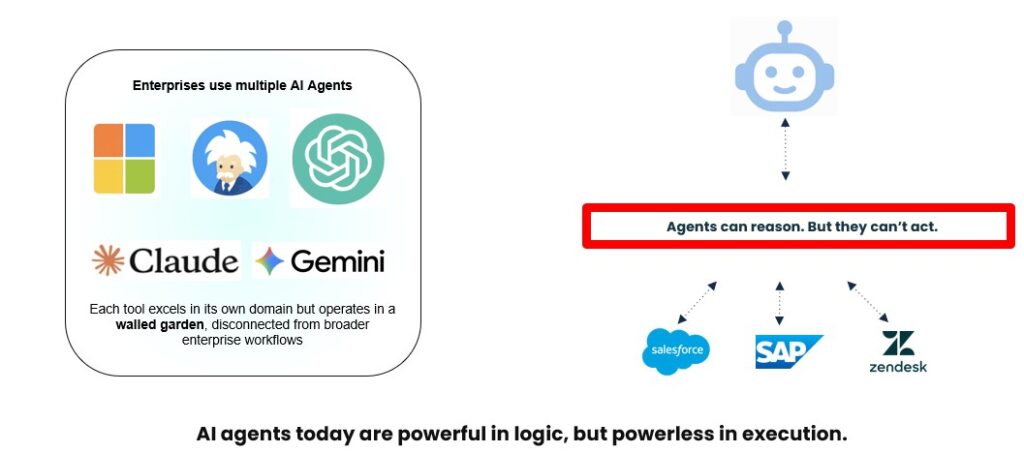
The AI Implementation Gap: From Pilot Proliferation to Production Failure
Research from MIT estimates that approximately 95% of Generative AI projects fail to deliver measurable value, mainly because they are deployed without access to systems of record. While there is executive pressure to leverage AI to achieve productivity gains, studies show that most Generative AI initiatives fail to move beyond the pilot stage. Smaller, standalone projects are likely to succeed, whereas complex, high-value business processes are more likely to fail.
Obstacles to AI Project Success: Architectural Deficits and the Verification Tax
While many executives believe AI projects fail due to model shortcomings or insufficient reasoning, the primary reason is architectural issues. Most AI initiatives lack success because enterprises deploy them on architectures that lack governance, data integration, and access to enterprise systems of record.
Verification tax is considered the combined cost for human review, exception handling, reconciliation, and audit controls required to compensate for probabilistic outputs. When models are deployed without real-time access to the enterprise’s system of record, their results rely on training data that can lead to hallucinations. Data quality is the primary reason for failing to realize value from AI projects.
These architectural failures illustrate why enterprises experiment with AI at the edge but are reluctant to deploy it in core business processes.
Understanding the Edge vs. Core Divide
The Edge and Core framework is elaborated in a Harvard Business Review Analytic Services report, which highlights the trust gap in enterprise AI adoption. This trust gap explains why AI adoption remains confined to the edge, as described in the following sections.
Why AI Thrives at the Edge of Business
The Edge processes encompass peripheral business tasks, such as drafting a marketing piece or summarizing email threads. Applying Gen AI to these low-risk tasks is common because users can easily correct the results. The adoption of Gen AI tools for these tasks is widespread and often occurs independently, driven by self-motivated individuals within the organization.
Why Core Business Processes Still Resist AI
At the other end of the spectrum, Core encompasses end-to-end mission-critical tasks such as source-to-pay in procurement or hire-to-retire in HR. For these Core processes, the error tolerances are near zero. As a result, only 6% of IT leaders fully trust Agentic AI to handle Core business processes autonomously. This low trust stems from Agentic AI’s inability to ensure the trustworthiness of automated tasks.
Why the AWS–Workato Partnership Matters
With the high failure rates and lack of trust in Agentic AI, the AWS-Workato partnership addresses the need for an end-to-end AI stack that delivers value to customers. The end-to-end stack for production-ready AI is delivered combining AWS’s infrastructure and AI services with Workato’s integration and orchestration expertise. While AI models are adept at suggesting actions, businesses need those actions executed securely and reliably. Here is how the capabilities of both organizations come into play:
AWS: AWS provides AI models, powered by highly available infrastructure, that ingest data and generate predictions or recommendations.
Workato: Based on the recommendations and predictions, a decision should be made using data from systems of record. Workato provides a layer for connecting real business systems, such as HR and CRM, ensuring accuracy.
By combining each organization’s capability, you get a complete, end-to-end AI stack. Allowing an AI model to take actions is unacceptable in the real world. Workato takes those actions and wraps them in workflows. For example, in a customer service workflow, an AWS-hosted AI agent may determine that a customer is eligible for a refund based on contextual information from the conversation. Workato then validates the determination against CRM and ERP systems, applies business rules, routes exceptions for approval, executes the transaction, and records the action for audit and compliance.
Agentic AI implementations fail due to the lack of a governing framework for action. Moving the benefits from edge projects to core business processes requires deterministic orchestration that provides a well-governed method to execute actions safely.
Integration and Orchestration as the Control Plane
Companies attempted to perform core actions using custom scripts, which quickly failed in real-world, large-scale deployments. Enterprise-grade integration and orchestration transform experimental AI at the edge into a compliant business capability by managing state, identity, and auditability at scale at the core.
To be reliable, deterministic orchestration must handle:
State management: That can pause a process while awaiting human approval.
Identity management: Actions must be taken with explicitly granted permission.
Auditability: Each action must be traceable and evaluated against policy in real time, enabling subsequent review for compliance.
A common control plane separates probabilistic AI reasoning from deterministic execution, and integration and orchestration platforms enforce this separation.
Conclusion
Foundation models are expected to commoditize, shifting competitive advantage to enterprises that can safely operationalize intelligence across their core processes without the verification tax. While it is easy to blame inadequate models for the high failure rate in AI projects, the actual reason is deficient architecture. Turning AI insights into tangible business outcomes requires a sound integration and orchestration infrastructure.
The future of enterprise AI is not a monolithic platform delivered by one vendor. A combination of capabilities matters more than parameters or benchmark claims. Success will depend on collaboration among vendors such as AWS and Workato to strategically integrate capabilities across infrastructure and orchestration, compute and governance, AI services, and enterprise integration.
Organizations must invest in architectural foundations that support the adoption of agentic AI. That foundation is essential to make adoption safe, scalable, and sustainable.