
Introduction
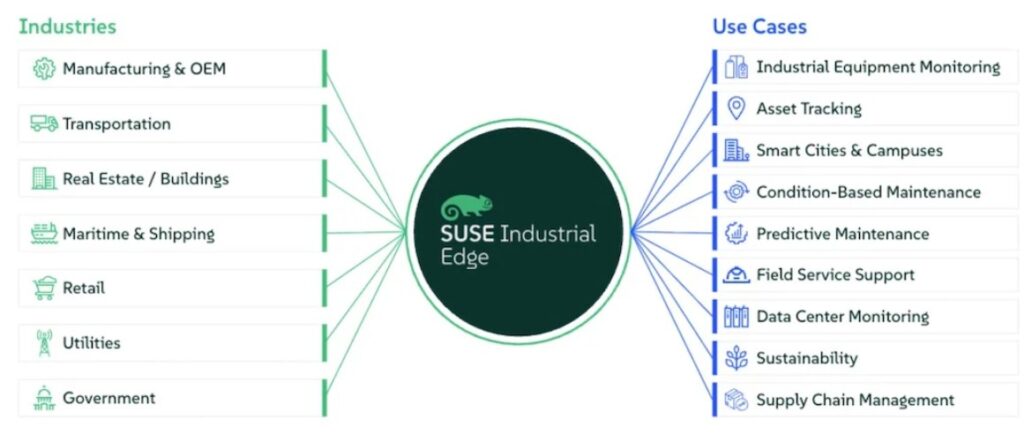
With the demand for improved efficiencies across a wide range of industries, automation is increasingly taking over manual tasks. The bottleneck there is still a chasm between sensor data collected at the device level and enterprise data that is core to business operations. For example, if a sensor highlights a maintenance issue and the automation software detects it, there is no visibility into whether the resulting production delay will affect a high-priority customer, since that information resides in the ERP system. The challenge spans industries, from manufacturing and retail to smart buildings and utilities. Macro events such as labor shortages, geopolitical volatility, and national security concerns amplify the value of a solution to address them. SUSE announced the SUSE Industrial Edge solution at its 2026 conference in Prague. At the conference, RobustCloud spoke with Keith Basil, VP & GM of the Edge Business Unit, to discuss this solution. Charlie Key, Director of Growth and Strategy, Industrial Platforms, was interviewed about various aspects of the solution; the interview is available here. Charlie Key was the co-founder of Losant, which SUSE acquired in February 2026 to add to its industrial Edge solution. The sections below examine the macro forces pulling industrial automation forward, what the Losant acquisition adds to SUSE’s stack, how the full end-to-end solution comes together, and the go-to-market hurdles SUSE still needs to clear.
Manufacturing’s Digital Reset
Manufacturing is undergoing fundamental reshuffling not seen in recent years. Reshoring is growing, with a large percentage of companies with overseas operations considering pulling some production back. As nations seek to reduce the risks of over-reliance on foreign sourcing, recent policy changes in both the US and Europe are tilting growth toward domestic capacity in industries such as semiconductors and batteries.
In high-cost locales, labor costs make it imperative for new production facilities to achieve maximum efficiency through automation. However, automation alone cannot drive efficiency without real-time data analytics combined with AI at the point of production. New production lines are being built with a digital framework from day one. And the new digitally native workforce is ready to replace the older generation of experienced workers. An automated, fully digitized plant also removes the stigma that factory work is mundane and low-paying. As an example, Ford is building a low-cost EV truck by rethinking its design to enable fully automated manufacturing.
Deloitte’s 2025 Smart Manufacturing and Operations Survey found that 80% of manufacturers are planning to allocate at least 20% of their budgets to smart manufacturing initiatives. This signals a growing addressable market for platforms like SUSE Industrial Edge. The same scenario as in manufacturing is playing out across multiple industries that are ready for a comprehensive solution to deliver on new business strategies.
Given the multiple business challenges organizations face, SUSE Industrial Edge must deliver connectivity across silos. SUSE’s February 2026 acquisition of Losant was a direct response to that need.
What Losant Brings to the SUSE Stack
SUSE acquired Losant in February of 2026, adding to its Industrial Edge solution. Before the acquisition, SUSE had a strong portfolio of edge infrastructure implementations. Losant’s capabilities complement the Industrial IoT application story for the following reasons:
1. Connecting IoT deployments: Most organizations have multiple production lines that are distributed within a geographic location or spread out across the country or the world. These silos of IoT deployments require a manual effort to get an organizational picture. With Losant’s visual workflow engine, a plant manager could gain operational awareness without manually correlating data in spreadsheets.
2. The AI platform: Model Context Protocol (MCP) is an open-standards protocol that allows AI models to connect to external tools and data sources securely. Losant adds to SUSE’s AI platform through an MCP integration, enabling AI agents to query the platform directly.
3. Open source commitments: SUSE intends to open source the Losant technology and has joined the Linux Foundation’s Margo Steering Committee. The Margo specification enables interoperability at the industrial edge to digitize industrial operations.
The acquisition of Losant accelerates SUSE’s ability to allow existing SUSE Edge customers to expand into the Industrial Internet of Things (IIoT) space without bringing in another vendor, which appeals to procurement teams. With Losant in place, SUSE now has a more complete portfolio for the SUSE Industrial Edge.
The Three Pillars of SUSE’s Industrial Edge
Connecting the industrial sensor to the rest of an enterprise’s digital portfolio of applications usually involves a hodgepodge of components. Some of the factors that contribute to SUSE becoming an end-to-end component stack are:
1. Open source all the way: The open-source components include the SUSE Linux Enterprise Server, SUSE Linux Micro, K3s, Rancher Prime, SUSE Storage, SUSE Virtualization, SUSE AI, and SUSE Industrial Edge. The Tiny Edge is where foundational sensor data resides. The combination of Tiny Edge and IIoT application platforms that use open protocols meets most customers’ needs.
2. Neutrality: Most automation vendors work very well within their own product ecosystem. Since SUSE does not have any industrial hardware in its portfolio, it can treat any industrial automation vendor, such as Rockwell or Siemens, equally. Vendor neutrality is important as multiple automation vendors often support large plants.
3. Economics: Operational Technology (OT) software is often priced based on the number of tags and PLCs. As enterprises reshore manufacturing, SUSE’s subscription services can flatten the cost curve when many sensors are involved in the solution.
A broader product portfolio, while essential, is not sufficient. SUSE still has to win over a buyer base not accustomed to IT vendors.
The Go-to-Market Hurdles Ahead While SUSE has many advantages enumerated above, it faces a go-to-market challenge in an industrial automation market dominated by entrenched players whose solutions are deeply embedded in facilities, and the plant managers and control engineers who make purchasing decisions tend to be skeptical of new vendors. To overcome these barriers, the following actions should be taken:
1. SUSE must leverage partnerships with automation vendors who have little interest in maintaining Linux distributions. A win-win situation for partners will expand SUSE’s avenues to acquire new customers.
2. Position SUSE, through Margo membership, as the neutral software layer connecting multiple OT ecosystems. Customers prefer a reliable partner to connect a wide range of systems.
3. Expand its presence at academic institutions to build brand awareness among the next generation of industrial technology decision-makers. With a skills shortage, the next generation of employees needs to be well aware of solutions to deliver positive outcomes to their employers.
Conclusion
As stated above, multiple factors are driving growth in industrial automation. Organizations need appropriate tools for digitization to survive and thrive amid rapid changes driven by geopolitical uncertainties. As automation grows in existing facilities or is adopted in brand new plants, so will the demand for solutions that can digitize the entire physical process. If SUSE can overcome market hurdles, it will meet the market need to combine IT and OT and address a perennial pain point. Industrial automation vendors do not understand cloud-native infrastructure, while hyperscalers cannot easily operate in air-gapped environments. SUSE is a vendor with Kubernetes credibility, without proprietary OT hardware, but with protocol support to enable connectivity. The shift towards a software-defined automation environment creates an entry point for SUSE into the industrial world. SUSE’s support of open standards meets the needs of both manufacturers and automation vendors. As a result, the SUSE Industrial Edge solution could be preferred by organizations with a vision to fully digitize their operations.