
Introduction: Amazon Quick shows how AWS is moving beyond model access and cloud AI services. This AWS service is an agent that can connect local files, email, cloud storage, web content, and enterprise workflows, providing enterprise knowledge workers with context assembly, task execution, and productivity across fragmented information sources.
After Amazon held an event titled “What is next with AWS”, RobustCloud covered all the announcements with a blog post. Amazon Quick was intriguing as it joined several similar offerings by other companies. RobustCloud followed up with an in-person briefing with John Brock from the AWS Agentic AI team at Amazon’s Seattle offices. The following blog post covers questions answered during the in-person briefing and the experience of using the Amazon Quick native desktop application.
Turning Model Choice into Intelligent, Cost-Optimized Routing
When asked about support for alternative models, it was confirmed that Amazon Quick will offer options to use Anthropic and other models. Giving customers a model choice helps, as it can drive traffic toward the best-performing and most appropriate LLM for each use case. In an age when AI spending is spiraling out of control, Amazon Quick could go a step further by evaluating the prompt or workflow request and automatically directing inference to the most cost-efficient model. Amazon’s own Nova could play an increasingly important role by addressing customer needs while further lowering costs. With this approach, model selection goes from a manual decision to an intelligent, cost-optimized routing layer. As a result, AWS could control costs and pass them down to customers.
Closing the Deployment Gap with the Innovation Center
Enterprise AI adoption often stalls between prototype and production. To overcome this, several LLM vendors, such as OpenAI and Anthropic, are investing in forward-deployed engineering ventures. The assumption is that engineers located in customer environments close the deployment gap. When asked about AWS’s equivalent offerings, representatives shared information about AWS’s Generative AI Innovation Center, which takes a different approach to achieving the same goals. The Center combines AWS scientists and AI experts with a 22-member partner Innovation Alliance, including Deloitte and Capgemini, to move customers from idea to production in as little as 45 days. There are several reasons why this model will work for customers. First, it can scale without eating into margins. Repeatable frameworks that partners can consume make every deployment faster than the last. Second, it avoids model lock-in. Built on Amazon Bedrock, the platform lets customers swap models as needs change. Third, mid-market customers who cannot afford long projects are likely to find solace in partner-delivered solutions that can be delivered in a short engagement cycle.
As an example of a partner-delivered solution, Kitsa (a health-tech company) used Amazon Quick Automate to build a process automation solution with an AI-powered workflow that automatically extracts and analyzes over 50 distinct data points from hundreds of thousands of websites. While maintaining full regulatory compliance, the solution processed what previously took months in days. AWS shared that the solution was built with a team of fewer than 5 using Amazon Quick, validating the ‘prototype to production’ speed.
Weaving Connective Tissue Across Every Data Source
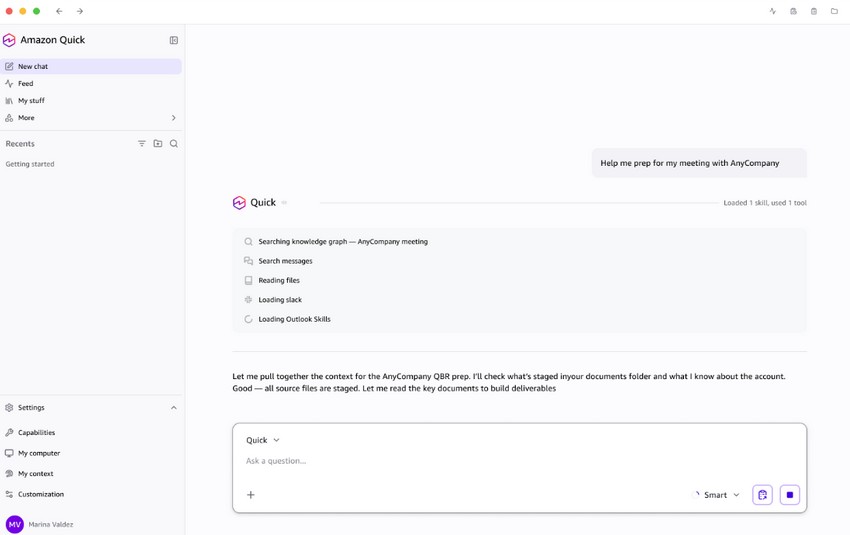
My personal experience with Amazon Quick Desktop was connecting various sources of information from my laptop to gather insights. When used in conjunction with an LLM and external sources, the insights can improve both the quality and productivity of an independent analyst. Unlike analysts at large analyst firms, independent analysts lack dedicated research teams, CRM platforms, or survey data. Setting up Amazon Quick is described below, followed by an explanation of how RobustCloud improved quality with less effort.
1. Addressing information fragmentation:
a. Local files: This contains past reports, vendor presentations, interview notes, as well as past blog posts.
b. Gmail: Correspondence, briefing invitations, and project discussions.
c. Google Drive and OneDrive: A collection of reference materials.
d. The internet: press releases and product documentation
2. Setting up data sources:
a. Agent access: Allow AI read and search access.
b. Keyword search: Enables full-text indexing.
c. Semantic search: This adds vector embeddings for meaningful retrieval.
d. Knowledge graph extraction: This maps projects, people, and relationships.
Amazon Quick helped RobustCloud with the following tasks:
1. Accelerating first drafts with grounded source material: Stating opinions about tech transformation, like product announcements or acquisitions, can take time to complete the piece. A lot of time is spent organizing the piece and stating the facts. Amazon Quick can draw on actual source material from a prompt, like real quotes from emails and briefing notes, while maintaining consistency with previous posts. Since Amazon Quick uses local data, first drafts require much less revision than with a general-purpose AI.
2. Mining relationship history for business development: Independent analysts do not have a shortage of opportunities, but there is also a desire to work on interesting projects. With over 60,000 emails over the past 14 years, it is impossible to analyze and show insights. With a simple prompt like: “Find emails with <vendor-name> representatives and who should be followed up with for opportunities”, a user can get a gold mine of information. Without a sales team or a CRM system, independent analysts can now be on par with large firms for scouting opportunities.
3. Preparing event and meeting dossiers in minutes: Given a prompt, Amazon Quick spawns multiple tasks in parallel to prepare for upcoming meetings. One task may scan e-mail, another look at local files for examples, and yet another scan the web for context. At the end of all tasks, the results are integrated into a well-organized dossier for perusal. This process saves hours of manual research done sequentially into minutes of automated tasks done in parallel.
4. Turning briefing notes and market signals into new research ideas: With access to recent client interactions from both email and local files, Amazon Quick can gather trends and suggestions for new blog posts. Furthermore, the product can provide ideas for improving the write-up by combining local context with a web search of the latest industry news using notes taken during vendor briefings.
The following characteristics of Amazon Quick help with making it your day-to-day dashboard:
1. Integrated search: A single query launches a simultaneous search across local files, email, and the web.
2. Persistent memory: Remembering the context from previous sessions.
3. Folder controls: Control over sensitive content using the ability to choose which folders to expose.
4. Offline capability: Local file access and code execution work without an internet connection (though LLM calls require connectivity)
One aspect of Amazon Quick Desktop is its knowledge graph, which learns from usage and connects the dots among documents, emails, and messages. As Amazon Quick develops a richer understanding of your work, the knowledge graph gives a comprehensive view of projects and relationships.
Two examples shared by Amazon were 3M and Mondelēz International, which validate how fragmented data sources are connected. 3M uses Amazon Quick to synthesize sales data from multiple platforms and automate administrative tasks, while Mondelēz International uses Amazon Quick as ‘the foundation for workforce AI augmentation across day-to-day work.’ For examples of customers with well-governed automation principles, refer to New York Life, which reimagined complex workflows across structured + unstructured data, and the NFL Next Gen Stats, which built the NFL IQ AI Assistant on Amazon Quick.
Conclusion
Connecting fragmented information sources is a table stake for knowledge discovery. Amazon Quick achieves this through a context layer that crosses personal, local, cloud, and enterprise data. Consolidating information from a wide array of sources enables scattered work contexts to become agentic workflows. Automating the manual task of fishing for facts reduces time spent on context assembly and increases time spent generating insights for analysts and knowledge workers.
While AI is a promising avenue for improved productivity, there are still concerns about data privacy and accuracy. With several customers already trusting AWS with sensitive data, the opportunity for AWS is to combine Amazon Bedrock and associated capabilities into a practical agentic AI platform on the desktop. Amazon Quick’s success will depend on whether AWS can deliver positive outcomes through well-governed, trustworthy automation at enterprise scale.