Introduction
KubeCon + CloudNativeCon Europe marked a transition in which Kubernetes is no longer the center of gravity, but AI agents are. And open source is now defining the infrastructure layer beneath them. An analyst briefing led by Jim Zemlin, Jonathan Bryce, and Chris Aniszczyk was held in conjunction with KubeCon + CloudNativeCon Europe. This year, the message was less about what is new with Kubernetes and more about how Agentic AI is being leveraged in enterprise software. Cloud Native Computing Foundation (CNCF) and Linux Foundation leaders spoke about how adoption of Agentic AI is accelerating, but success depends on plumbing and governance. There were three overarching themes communicated during the briefing. A standards layer to keep agent ecosystems interoperable, followed by cloud-native technology for scalable agents and inference workloads, and, finally, trust and security that is essential for the ecosystem to be sustainable. This blog post covers the top announcements made at the event.
Standards Become the Control Plane for Agentic AI
As the use of AI evolves from stateless, prompt-based responses to stateful, goal-driven workflow actions, the importance of interoperability standards across systems increases. Better models alone are not enough. Agentic systems require standardized protocols for interfacing with multiple tools and services, without the need for custom-built, brittle integrations. In December 2025, leading model providers Anthropic and OpenAI along with Block joined all the hyperscalers to form the Agentic AI Foundation (AAIF) to address this pain point. As a sign of this foundation’s importance, an additional 97 members joined in February 2026, bringing the foundation’s community to 146 members. In addition to MCP as the overall protocol, domain-specific protocols like the agentic Commerce Protocol (ACP) emerge to connect buyers and businesses to complete purchases.
Without shared protocols, agent ecosystems will likely fragment into vendor silos reminiscent of the early cloud era. With the momentum of adoption, the Linux Foundation is planning a series of events to bring together AI standards practitioners to collaborate.
The cloud native workload optimization and portability challenge
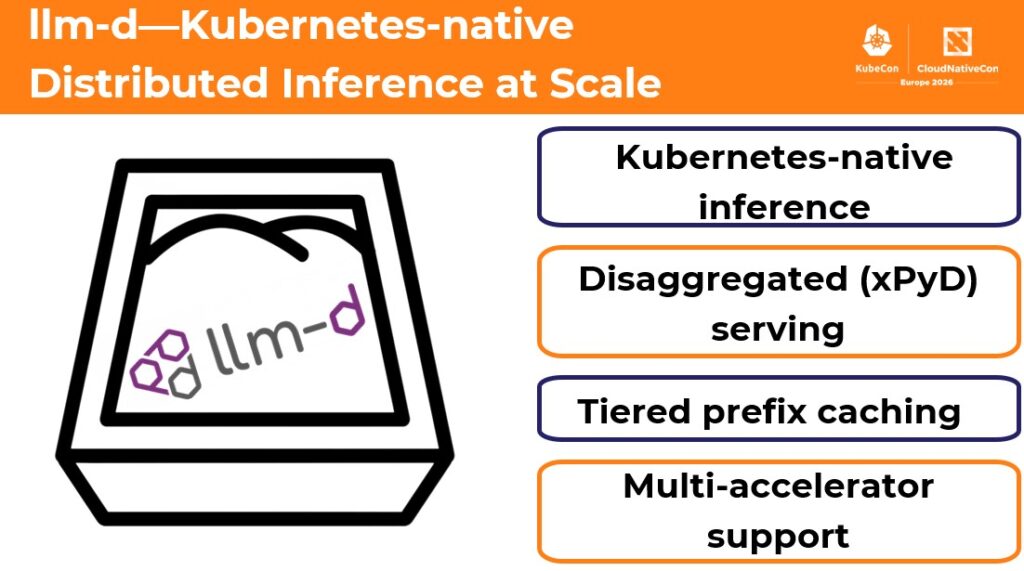
Inference at scale is now the operational bottleneck for AI workloads. Linux Foundation presenters shared predictions that the share of AI compute going to inference will be 67% in 2026, up from 33% in 2023. This shift exposes a new operational bottleneck of controlling inference cost and complexity at scale so that AI investments still pay off. Red Hat stepped up to the plate by contributing llm-d to CNCF as a Sandbox project (See Figure 1). With community participation in its success, llm-d turns LLM inference from a fragile, expensive experiment into scalable, cloud-native, sovereign-capable infrastructure. Leveraging llm-d could help remove bottlenecks in inference workloads and keep AI costs predictable. At the briefing, Brian Stevens from Red Hat framed the move as a step toward standardizing distributed inference as a portable, cloud-native capability.
Given the need for portability to run AI workloads on Kubernetes across any infrastructure that enables execution, community-led standards that ensure compatibility are important to users. The Kubernetes AI Conformance Program was released at KubeCon + CloudNativeCon Atlanta in November 2025 to ensure portability and vendor neutrality.
Trust is the Missing Layer in Autonomous Systems
OpenClaw grew in popularity very rapidly due to its ability to work as an autonomous AI agent. However, it quickly drew scrutiny due to its design, which introduced significant vulnerabilities with real-world risks of data exfiltration and privilege escalation. Autonomous agents expand the attack surface beyond traditional software. To alleviate concerns about using open-source AI tools, the Linux Foundation secured 12.5 million USD to strengthen the overall security of the open-source software ecosystem, including the supply-chain security. In the rapidly changing AI ecosystem, this initiative, which provides funding and tools to help maintainers identify vulnerabilities, can reduce the risk of bad actors gaining access to the ecosystem. The results of this funding can help address the open-source community’s long-term security needs.
The takeaway from the conference is that open source is no longer supporting AI but standardizing how autonomous systems operate across vendors, clouds, and ecosystems. The Linux Foundation and CNCF are moving in a direction that sets up the infrastructure software components companies need as they transition to delivering AI solutions securely. The three focus areas are ideal for helping the open-source ecosystem move into an AI-driven economy. Standardized agent connectivity removes barriers to integrating AI models with tools. Domain-specific protocols reduce barriers to adoption. The llm-d sandbox project supports optimization and portability, while the conformance program ensures that multiple vendors support the same standards, enabling coordination. Funding maintainers improves the security posture, leading to a more predictable future for open-source software.
There were about 13,500 attendees, making this the largest KubeCon + CloudNativeCon event and showing that interest in open-source software continues to grow. Open source is no longer just enabling AI workloads; it is defining the operational model for autonomous systems. With this momentum, we are likely to see additional interest in future events and a plethora of new projects in the AI ecosystem.