
Kubernetes won. But at what cost?
Since its open-source release in 2015, Kubernetes has rapidly become the industry standard for container orchestration. Its promise of portability, scalability, and high availability has driven adoption across enterprises and start-ups alike. Yet for many organizations, the benefits are tempered by the realities of day-to-day operations. Security, networking, patching, and a shortage of skilled Kubernetes practitioners all create extra work that can slow down innovation and inflate costs.
Teams often set out to modernize applications and accelerate delivery, only to find themselves spending more time managing infrastructure than building products. For these organizations, the problem is not Kubernetes itself; it is the operational complexity that comes with running it at scale.
The Real Cost of Kubernetes Is Hiding in Plain Sight
Kubernetes’s constant evolution requires dedicated engineering resources for cluster upgrades and testing while maintaining high availability. Critical tasks such as node provisioning, load balancer configuration, and applying security patches are time-consuming. These resources should be directed toward delivering customer value.
Self-managed Kubernetes environments frequently obscure their actual costs. While cloud compute and storage expenses are easy to measure, hidden costs lie in operational complexities demanding ongoing attention. Each deployment requires script adjustments, performance tuning, and maintenance of custom autoscalers. Without sufficient scale, maturity, or capability, many organizations struggle to justify the investment.
These challenges have a real business impact. Production environment setups that should take days can stretch into months. Deployments require complex provisioning and multi-environment testing, slowing the pace of business transformation. Skilled Kubernetes engineers are in short supply, creating bottlenecks and increasing the burden on existing teams. Maintaining high availability demands constant vigilance over scaling, configuration, and patching, forcing teams into a costly tradeoff between over-provisioning resources and risking performance issues.
Security and compliance requirements further increase the stakes. Teams must ensure consistent access controls, stay ahead of critical security patches to avoid common vulnerabilities and exposures (CVEs), and maintain compliance across environments. Manual processes heighten the risk of misconfigurations, compliance violations, and downtime. When so much of the engineering effort is consumed by maintenance, organizations inevitably lose focus on innovation.
The Goal Isn’t More Control — It’s Less Complexity
For every hour spent fine-tuning Kubernetes internals, competitors are releasing new features and advancing their market position. Forward-thinking teams are asking an important question: What if you could retain all the benefits of Kubernetes without carrying the operational burden?
Simplifying Kubernetes: Amazon EKS Auto Mode
Amazon EKS Auto Mode represents a fundamental shift in how Kubernetes can be operated. By transferring much of the infrastructure management responsibility to Amazon Web Services (AWS), Amazon EKS Auto Mode allows teams to focus on applications instead of infrastructure. Figures 1 and 2 below depict how the responsibility of managing services moves from the customer to AWS.
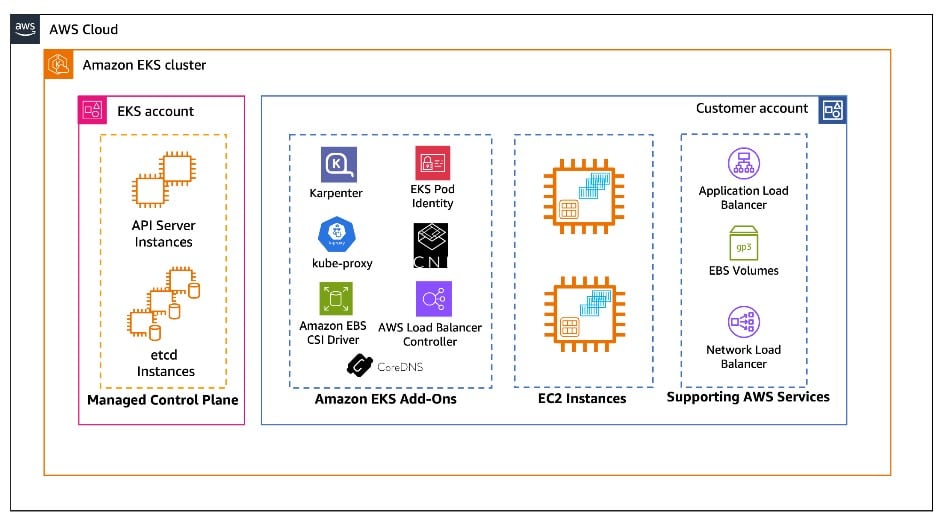
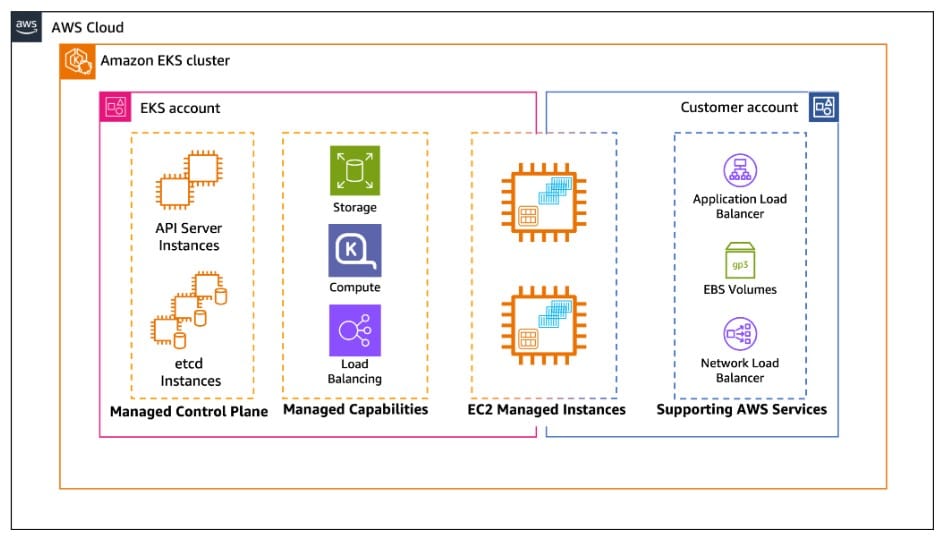
Products built on open source initiatives give customers transparency, flexibility, and community- driven improvements, resulting in faster innovation with trustworthy solutions. At its foundation, Amazon EKS Auto Mode is powered by Karpenter, the open-source Kubernetes cluster autoscaler. Karpenter dynamically provisions and terminates compute resources in response to workload demands while continuously optimizing cost efficiency and performance. This eliminates the need for custom autoscaler maintenance and reduces the risk of misconfiguration.
Amazon EKS Auto Mode automates the entire cluster lifecycle—from compute setup and load balancing to applying security patches and managing node upgrades. Nodes are immutable and refreshed on a 21-day cycle, ensuring a secure, consistent environment. Networking, storage, and identity and access management are integrated as built-in features for supported workloads, eliminating much of the manual configuration work that slows teams down.
For IT teams without deep Kubernetes expertise, Amazon EKS Auto Mode applies AWS best practices automatically, embeds operational security, and integrates compliance controls by default. Governance and cost optimization become foundational rather than optional add-ons. AWS automatically handles node group provisioning, autoscaler setup, and compatibility with storage and network plugins, freeing developers from manual cluster operations. Developers can focus solely on writing and deploying applications while Amazon EKS Auto Mode dynamically allocates resources and scales in real time. This drastically shortens development cycles and removes infrastructure-related blockers. Freed up from infrastructure provisioning or troubleshooting complex cluster issues, developers can entirely focus on delivering application features.
The shift toward simplified Kubernetes management reflects a broader industry transformation. As more organizations prioritize developer productivity and faster time-to-market, solutions like Amazon EKS Auto Mode represent the next evolution in container orchestration.
Understanding the Tradeoffs
While Amazon EKS Auto Mode offers significant operational benefits, organizations should carefully consider the following tradeoffs:
Abstracted Infrastructure Management:
Amazon EKS Auto Mode handles node group management and automates scaling, which streamlines operations for most use cases. But for teams that need deep OS-level control or custom AMI configurations, this abstraction can be restrictive. As an example, workloads requiring specialized kernel parameters or custom security agents may be better served with traditional EKS deployments.
Opinionated Operational Model:
Amazon EKS Auto Mode applies AWS best practices out of the box, which speeds up deployment and improves security in most situations. However, workloads with strict compliance requirements or specific networking needs may require additional evaluation. Organizations in regulated industries or high-performance computing environments should assess whether their use case requirements align with Amazon EKS Auto Mode’s operational model.
Amazon EKS Auto Mode has received updates over the past several months, with enhancements aimed at increasing flexibility. Organizations should check here for the latest features.
Conclusion
The future of Kubernetes is not about gaining more granular control but about reducing operational friction so teams can build faster. Amazon EKS Auto Mode is a clear example of how automation can deliver on that promise, taking on the undifferentiated heavy lifting while maintaining enterprise-grade security and governance.
Managing complex Kubernetes infrastructure operations can delay product plans and hinder organizations’ agility and competitiveness. Reducing that complexity positions organizations to move faster and take advantage of market opportunities.
Note: This blog post, co-developed with
AWS, is the first part of a 2-part series. The second installment will cover
challenges faced by start-ups in managing cloud workloads and how managed
clusters help overcome these hurdles.